
SEO results need to be viewed within the entire customer acquisition funnel — if you want to first define your investment boundaries, you can use Go-Global Quote Calculator Get a budget estimate, or go to Overseas Growth Knowledge Base Go through the checklist item by item.
Layer one: Search intent — are the keywords you’re ranking for the ones your customers use when they’re ready to buy?
| Keyword type | Typical signal words | Example | Client status | Inquiry conversion value |
|---|---|---|---|---|
| Research keywords | best / top / review / vs | best solar inverter | Comparing brands, not ready to buy | Low |
| Purchasing keywords | price / wholesale / supplier / OEM / factory | solar inverter wholesale price | Price comparison, supplier inquiries | High |
If the top-ranking keywords are all research-type terms, it’s normal for traffic to rise without inquiries following. The key judgment: whether a keyword is worth pursuing depends first on whether it carries purchasing intent, not on search volume. Self-check method: pull out the keywords that actually bring in inquiries, look for common characteristics, and work backward to adjust your content mix — aim for precision, not volume.
Layer two: the landing page — the keyword is there, but does the page deliver?
Google brought customers to the right keyword, but the landing page didn’t capture the intent. The three most common gaps in B2B procurement: the page reads like a “company introduction” (missing specs, parameters, certifications, MOQ); the site only has a homepage and product listing (no dedicated page for that keyword); the content isn’t in the target market’s native language (they can understand it but don’t trust it). Self-check: open Search Console, look at your highest-impression keywords, and ask yourself, “Can a first-time overseas buyer find the specs and contact info within 30 seconds?”
Third layer: Trust signals — B2B decision-makers inspect first, then inquire
Overseas customers won’t send an inquiry just because they saw your product page. First they need to confirm “you’re a real, reliable company that can supply long-term.” Common gaps: no real case studies / client logos / third-party certifications (CE, UL, ISO); company intro with no verifiable facts (founding year, real factory photos, team); no tangible sense of a physical presence (address, phone, social media updates). Self-check: pretend you’re a new customer browsing your site and count the pieces of evidence that would convince you this company is trustworthy. If there are fewer than 3, it’s no surprise inquiries are low.
Layer four: conversion path—every extra step loses another layer of users
- Too many form fields — the drop-off difference between 11 fields and 4 fields is far bigger than most people think;
- Only a form, with no instant communication channels (WhatsApp, live chat, direct email link);
- No time zone consideration—a customer inquires in the US afternoon, you see it the next morning, and the golden follow-up window has already passed.
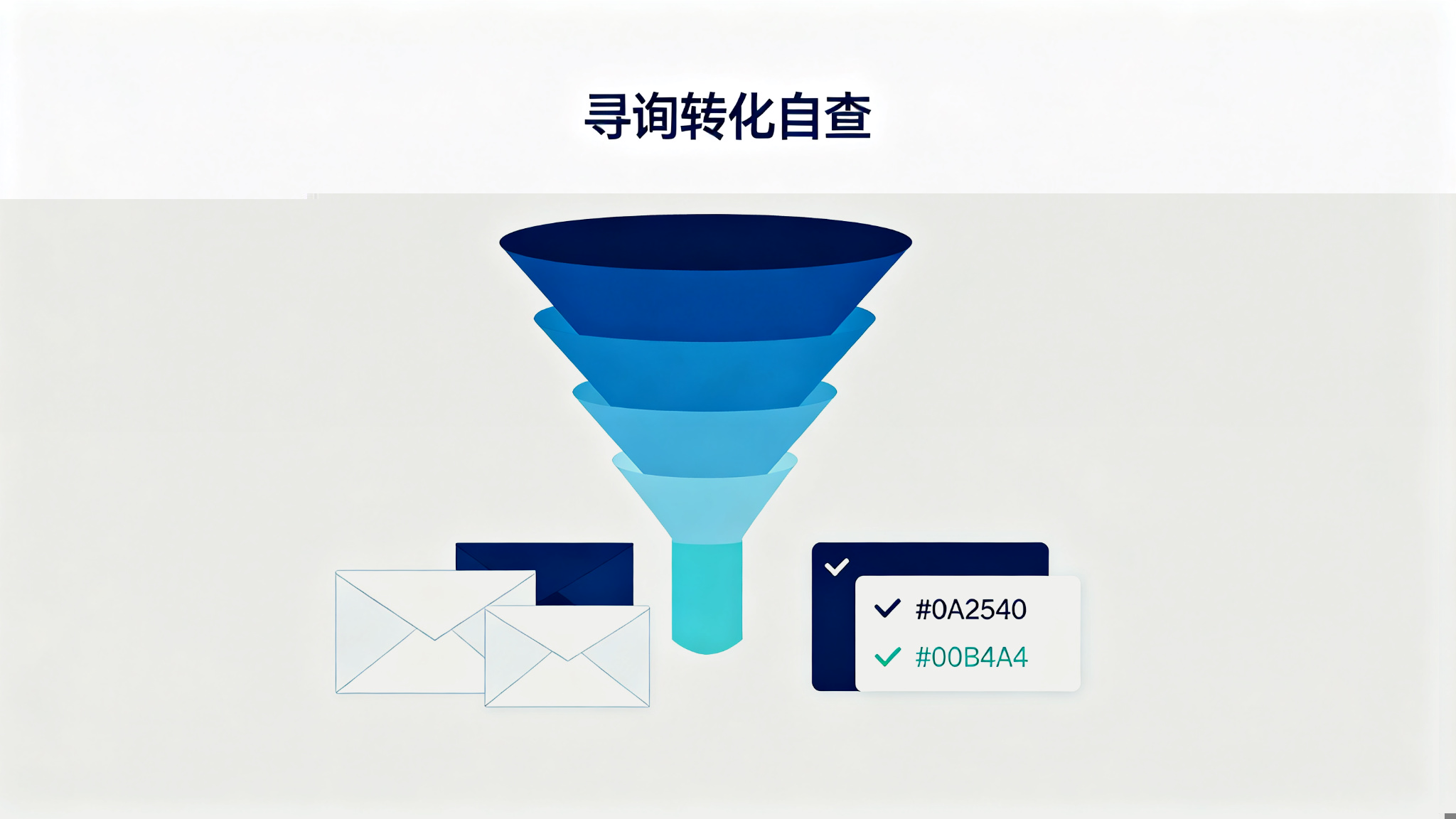
Self-check: Walk through the conversion path on a mobile phone, from an overseas perspective, during “non-China hours,” and note every point of friction.
Layer 5: Inquiry Follow-Up — The Speed of Your First Email Decides Half the Battle
Many sites actually do receive inquiries, but they die at the follow-up stage. Response speed, whether follow-up emails sound templated, whether anyone is actually monitoring the inbox — these aren’t part of lead generation, but they determine how much revenue inquiries ultimately convert into. If this layer isn’t managed well, no matter how well the previous four layers are done, ROI will be cut in half.
5-Layer Self-Check Quick Reference Table
| Tier | Core issues | Common Symptoms | How to judge |
|---|---|---|---|
| 1. Search intent | Do the keywords you rank for carry purchasing intent? | Traffic rises, inquiries don’t | Pull the source keywords for inquiries and look for common patterns |
| 2. Landing pages | Does the page capture purchasing intent? | High bounce rate, short dwell time | Find specs and contact info in 30 seconds from an overseas perspective |
| 3 Trust Signals | How much “verifiable evidence” is on the site? | High traffic, low inquiries | Fabricated evidence of new customer count—fewer than 3 is insufficient |
| 4 Conversion paths | How many steps from visitor to inquiry, and where’s the friction? | Abandon halfway through the form | Go through it on mobile + from an overseas perspective + during non-China time zones |
| 5 Inquiry follow-up | How quickly do emails get replies, and who’s monitoring them? | Inquiries come in, but few convert | Track response times, watch the 24–48 hour window |